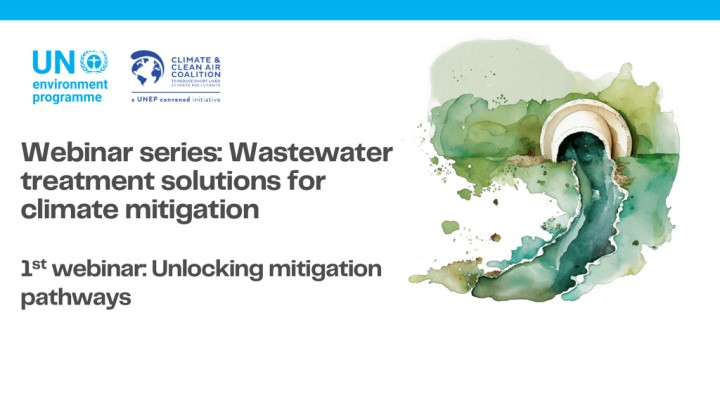
UNEP (2026) 1st Webinar Presentation: Unlocking Mitigation Pathways
Webinar Series: Wastewater Treatment Solutions for Climate Mitigation The first Webinar on "Unlocking Mitigation Pathways" took place on 06th May 2026. Key Takeaways: • The high level of engagement confirms that wastewater management is an increasingly relevant climate mitigation topic. • Stakeholders are ready to transition from conceptual discussions to implementation. • The most critical needs are practical tools, capacity building, and financing mechanisms. • Wastewater is increasingly being recognized not only as […]
Online since: 04.09.2026
Views: 0
Downloads: 91
SuSanA Secretariat (2026) 36th SuSanA Meeting - Presentations, Recordings and further Resources
The 36th SuSanA Meeting took place on 22 August 2026. It was organised by the SuSanA Secretariat with support and contributions from the Global Steering Committee, SuSanA Partners, Members, Working Groups, Regional Chapters, and many others. This page serves as a central collection point for various resources from the meeting, including recordings, presentations, and an overview of the programme. We would like to once again thank all […]
Online since: 27.08.2026
Views: 0
Downloads: 457
Environment and Public Health Organization (ENPHO) (2023) SFD (Level 2) Report - Bheri Municipality
Bheri is an urban muncipality located in Jajarkot district of Karnali Province of Nepal. The municipality comprises of 13 wards. The municipality covers an area of 219 .77 km2. According to national population and housing census 2021, the municipality has a total population of 37,892 and 8,874 households (NSO, 2023). The climate includes a subtropical monsoon along the Bheri River. According to data from the Department […]
Online since: 04.08.2026
Views: 0
Downloads: 189
Environment and Public Health Organization (ENPHO) (2024) SFD (Level 2) Report - Baglung Municipality
Baglung Municipality is situated in Baglung District of Gandaki Province in the western region of Nepal. It is divided into 14 wards and covers an area of 98.01 km2. It was established on January 31, 1997, by merging 3 Village Development Committees (VDCs) namely, Kalika, Mulpani and Laharepipal and was reformed on March 10, 2017 by merging 7 VDCs; Malika, Tityang, Bhakunde, Raya Danda, Amalachaur, […]
Online since: 31.07.2026
Views: 0
Downloads: 202
Environment and Public Health Organization (ENPHO) (2024) SFD (Level 2) Report - Gorkha Municipality
Gorkha Municipality is situated in Gorkha District of Gandaki Province in the western region of Nepal. It is divided into 14 wards and covers an area of 131.86 sq. km. It was established on January 28, 2014 by merging 3 Village Development Committees (VDCs) namely, Gorakhkali, Raniswara and Taranagar. It lies at 27°56ʹ03ʺ to 28°13ʹ07ʺ N latitude and 84°23ʹ to 84°38ʹ E longitude and […]
Online since: 31.07.2026
Views: 0
Downloads: 202
Centre for Advocacy and Research (CFAR) (2026) SFD (Lite) Report - Khordha
Khordha, located in eastern Odisha, serves as the district headquarters. The town is situated strategically along NH-16, linking Bhubaneswar and Berhampur. This corridor has strengthened the town’s administrative role, economic activities, and regional connectivity. Geographically, the town lies at 20°15′ N latitude and 85°37′ E longitude. The climate is tropical monsoon, with temperatures ranging from 10°C in winter to 42°C in summer and an average […]
Online since: 05.06.2026
Views: 0
Downloads: 363
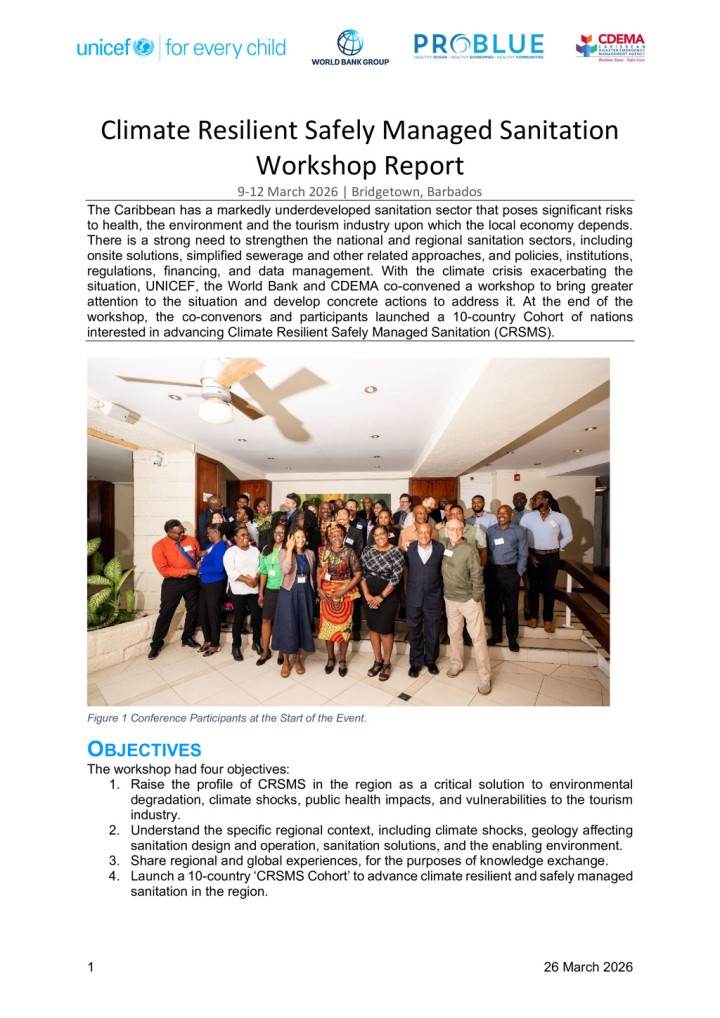
CRS Coalition (2026) Climate Resilient Safely Managed Sanitation Workshop Report
The Caribbean has a markedly underdeveloped sanitation sector that poses significant risks to health, the environment and the tourism industry upon which the local economy depends. There is a strong need to strengthen the national and regional sanitation sectors, including onsite solutions, simplified sewerage and other related approaches, and policies, institutions, regulations, financing, and data management. With the climate crisis exacerbating the situation, UNICEF, the […]
Online since: 24.04.2026
Views: 0
Downloads: 483
Oxfam (2025) WASH Climate Change Adaptation
Climate change is already having significant negative effects on the lives and livelihoods of people living in countries affected by conflicts and disasters. It is also making the provision of humanitarian support more difficult. This situation can be expected to get worse in the coming years. The humanitarian Water, Sanitation and Hygiene (WASH) sector faces particular risks and challenges. The increased temperatures resulting from global […]
Online since: 10.04.2026
Views: 0
Downloads: 4601
Environment and Public Health Organization (ENPHO) (2023) SFD (Level 2) Report - Bidur Municipality
Bidur, a municipality is situated in Nuwakot district of Bagmati Province, Nepal which is located at 69 km northwest of Kathmandu Valley. It comprises of 13 political wards and spread over an area of 130.01 square kilometres consisting of plains and hilly plateaus (Bidur Municipality, 2024). It has a total population of 59,227 individuals across 15,234 households (NSO,2021). It has subtropics and sub-humid climate, with […]
Online since: 09.01.2026
Views: 0
Downloads: 705
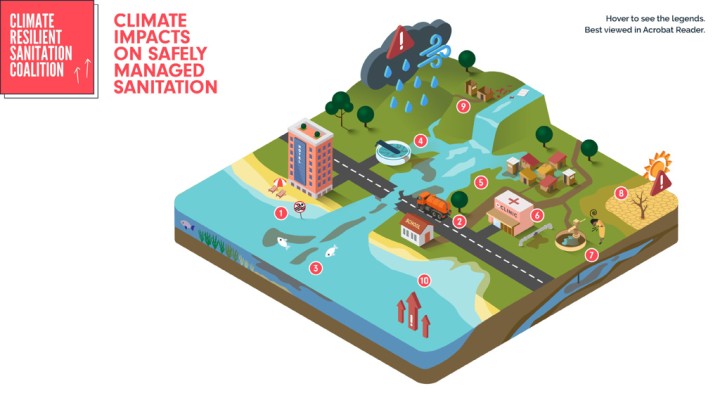
Climate Resilient Sanitation Coalition (2025) Climate Resilient Sanitation Infographic
This infographic highlights how climate change threatens sanitation systems and, in turn, public health, ecosystems, and economies. It illustrates ten key impacts - from flooding, storms, and droughts to sea level rise and groundwater contamination- showing how fragile sanitation infrastructure can trigger cascading effects on tourism, marine ecosystems, and essential institutions.
Online since: 15.09.2025
Views: 9
Downloads: 960
SuSanA (2025) 35th SuSanA Meeting - Presentations, Recordings and further Resources
The 35th SuSanA Meeting took place on 23 August 2025. It was organised by the SuSanA Secretariat with support and contributions from the Global Steering Committee, SuSanA Partners, Members, Working Groups, Regional Chapters, and many others. This page serves as a central collection point for various resources from the meeting, including recordings, presentations, and an overview of the programme. We would like to once again thank all […]
Online since: 25.08.2025
Views: 29
Downloads: 5285
Khemka, Rochi, and Eberhard, Rolfe (2025) Scaling Water Reuse: A Tipping Point for Municipal and Industrial Use - Executive Summary
Water reuse is no longer a marginal consideration; it is a strategic necessity. Around the world, cities and industries are under growing pressure from water scarcity, pollution, and climate stress. The treatment and reuse of used water offers a powerful and practical response—a dependable source that enhances water security, supports economic development, and strengthens climate resilience. This report makes a case […]
Online since: 04.08.2025
Views: 46
Downloads: 812
Khemka, Rochi, and Eberhard, Rolfe (2025) Scaling Water Reuse: A Tipping Point for Municipal and Industrial Use
Water reuse is no longer a marginal consideration; it is a strategic necessity. Around the world, cities and industries are under growing pressure from water scarcity, pollution, and climate stress. The treatment and reuse of used water offers a powerful and practical response—a dependable source that enhances water security, supports economic development, and strengthens climate resilience. This report makes a case […]
Online since: 04.08.2025
Views: 46
Downloads: 796
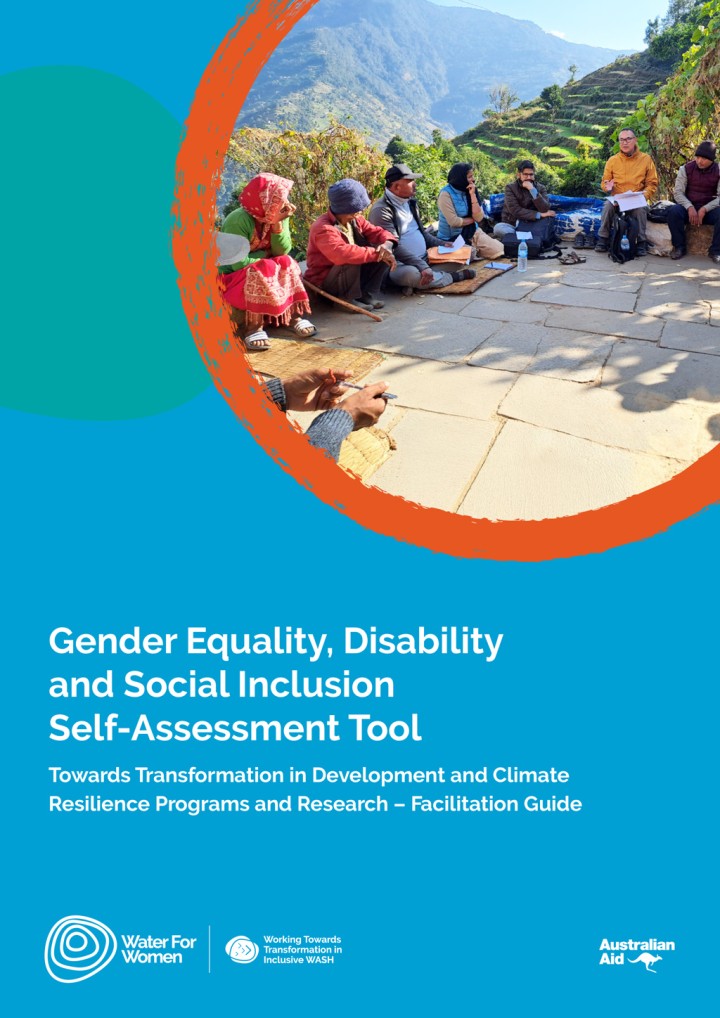
Water for Women (2025) Gender Equality and Social Inclusion Self-Assessment Tool (Revised Edition)
The Gender Equality, Disability and Social Inclusion Self-Assessment Tool (GEDSI SAT) is a facilitation guide for climate resilience and development program managers, GEDSI advisers, researchers and interested members of staff, designed to support individual and collective reflective practice on the extent and quality of gender equality, disability and social inclusion work in programs and organisations. Drawing on a wealth of experience from across Water for […]
Online since: 09.07.2025
Views: 53
Downloads: 593
Water for Women (2024) What Does Climate-Resilient Inclusive WASH Look Like? Insights from Water for Women
Under our collaborative Learning Agenda 2023-24, drawing on learnings from the implementation of climate-resilient and inclusive WASH projects and research across Asia–Pacific, partners sought to explore this fundamental learning question through a series of dedicated initiatives.
Online since: 09.07.2025
Views: 57
Downloads: 495
Nupur Khanna; Tanvi Oza; Paul Johnston (2023) Climate Finance for WASH: Papua New Guinea
Water, sanitation and hygiene (WASH) is integral to supporting community climate resilience that ensures no one is left behind. Inclusive, climate-resilient WASH goes beyond infrastructure to ensure that solutions meet the needs of the most marginalised and can continue functioning in the face of climate hazards. Accessing climate adaptation financing for WASH projects has been a challenge for civil society organisations (CSOs) due to a […]
Online since: 09.07.2025
Views: 52
Downloads: 554
Habib Ur Rehman; David Clatworthy (2023) Climate Finance for WASH: Pakistan
Water, sanitation and hygiene (WASH) is integral to supporting community climate resilience that ensures no one is left behind. Inclusive, climate-resilient WASH goes beyond infrastructure to ensure that solutions meet the needs of the most marginalised and can continue functioning in the face of climate hazards. Accessing climate adaptation financing for WASH projects has been a challenge for civil society organisations (CSOs) due to a […]
Online since: 07.07.2025
Views: 46
Downloads: 459
Wahyu Triwahyudi (2023) Climate Finance for WASH: Indonesia
Water, sanitation and hygiene (WASH) is integral to supporting community climate resilience that ensures no one is left behind. Inclusive, climate-resilient WASH goes beyond infrastructure to ensure that solutions meet the needs of the most marginalised and can continue functioning in the face of climate hazards. Accessing climate adaptation financing for WASH projects has been a challenge for civil society organisations (CSOs) due to a […]
Online since: 07.07.2025
Views: 59
Downloads: 497
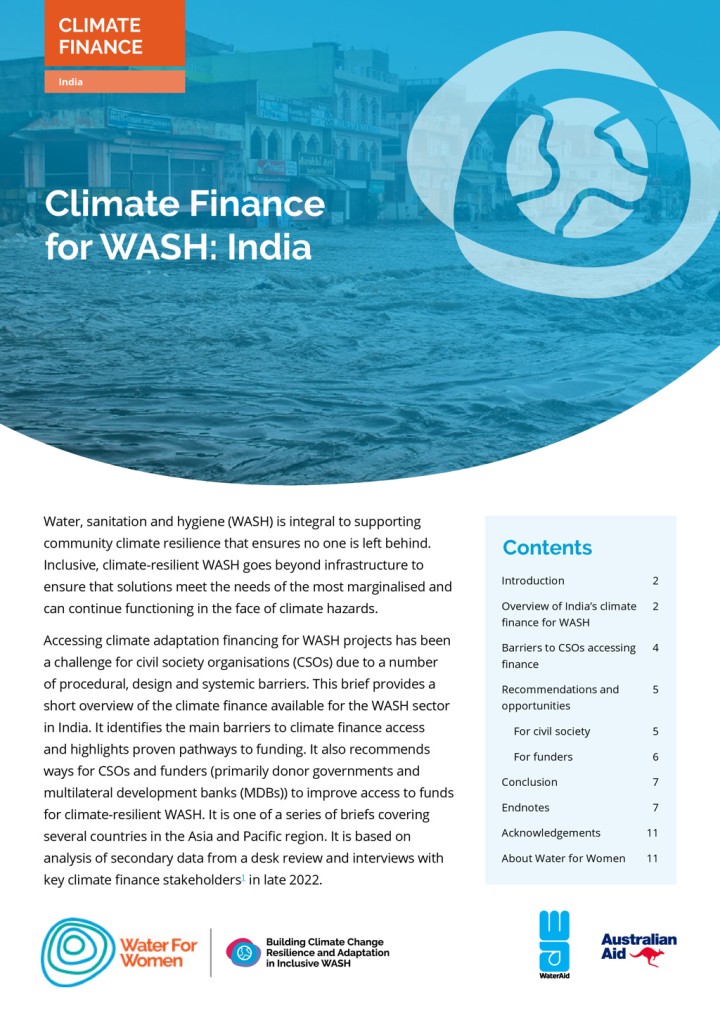
Anirban Chatterjee (2023) Climate Finance for WASH: India
Water, sanitation and hygiene (WASH) is integral to supporting community climate resilience that ensures no one is left behind. Inclusive, climate-resilient WASH goes beyond infrastructure to ensure that solutions meet the needs of the most marginalised and can continue functioning in the face of climate hazards. Accessing climate adaptation financing for WASH projects has been a challenge for civil society organisations (CSOs) due to a […]
Online since: 07.07.2025
Views: 53
Downloads: 500
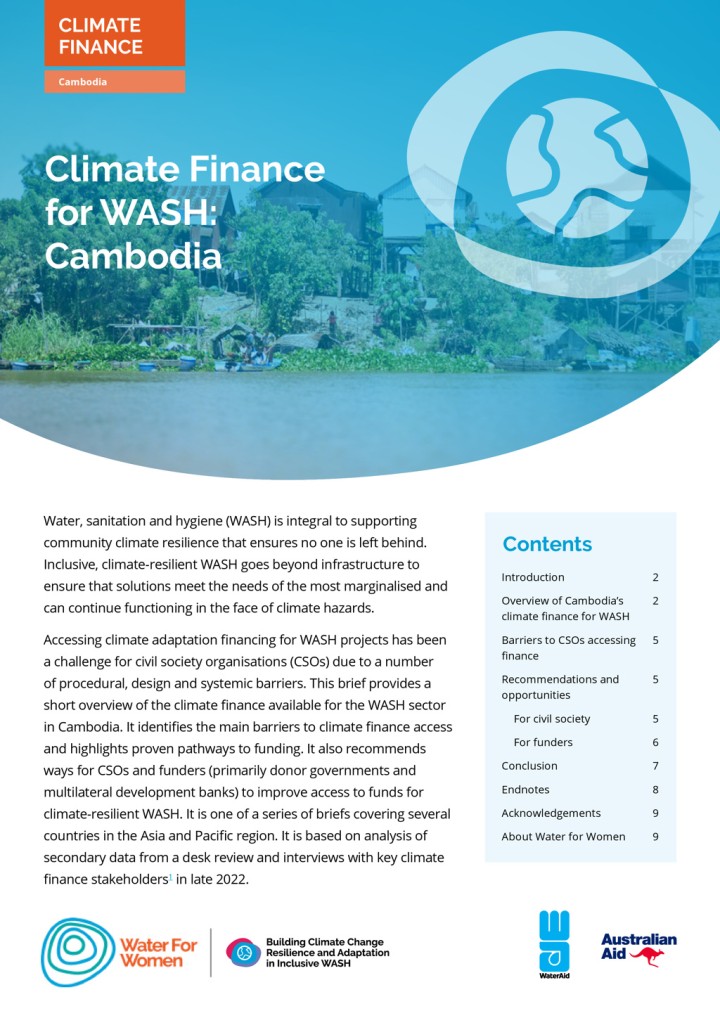
Paul Johnston; Tyler Kozole (2023) Climate Finance for WASH: Cambodia
Water, sanitation and hygiene (WASH) is integral to supporting community climate resilience that ensures no one is left behind. Inclusive, climate-resilient WASH goes beyond infrastructure to ensure that solutions meet the needs of the most marginalised and can continue functioning in the face of climate hazards. Accessing climate adaptation financing for WASH projects has been a challenge for civil society organisations (CSOs) due to a […]
Online since: 07.07.2025
Views: 59
Downloads: 465