Climate Impacts on Safely Managed Sanitation
Hover to see the legends.
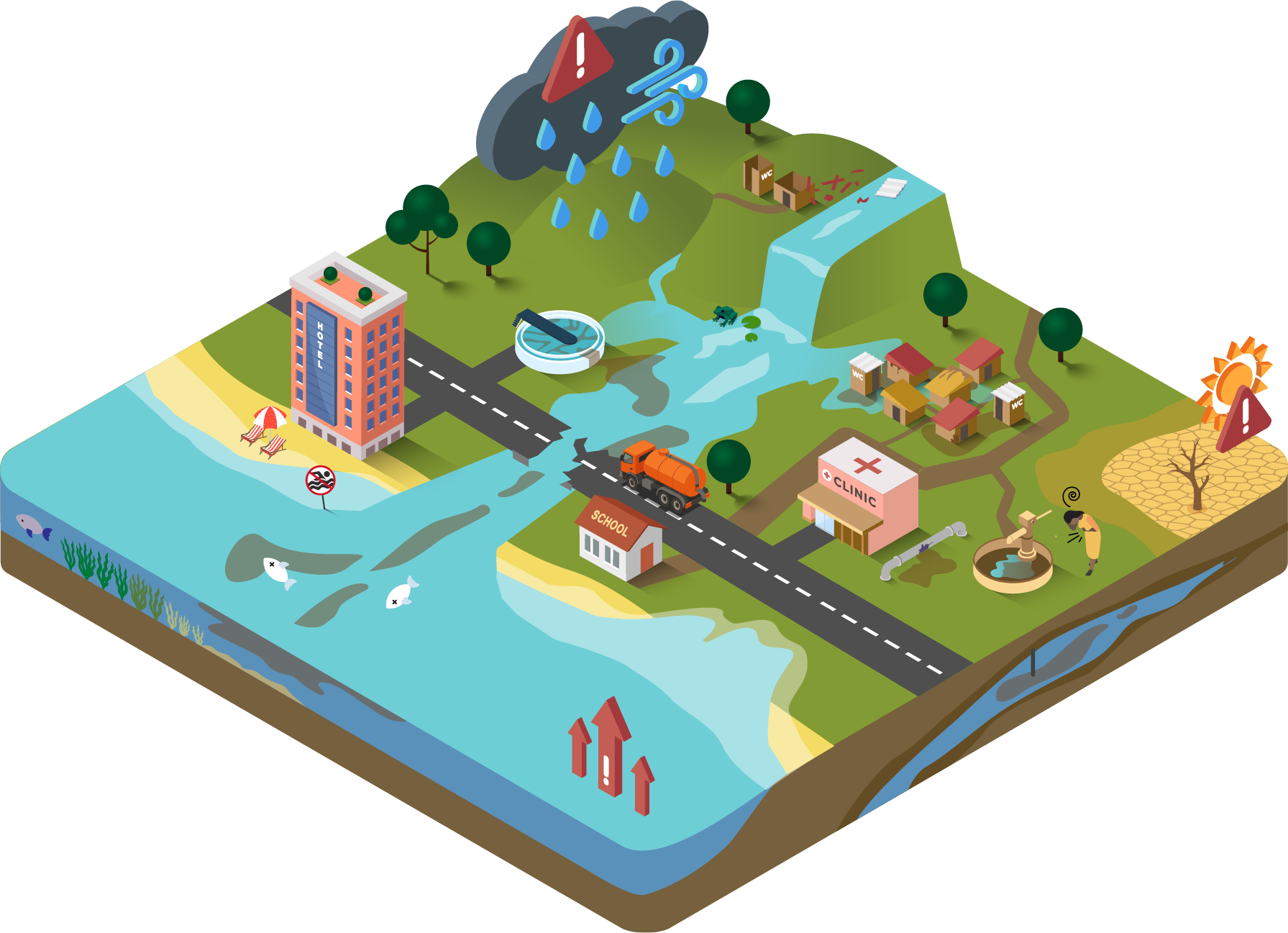


1 Hotel/Tourism
Tourist destinations face multiple impacts from climate shocks and poor sanitation, including lost attractions, contaminated coral reefs, and unsanitary beaches. The World Bank has calculated that in India alone, poor sanitation results in US$260 million in tourism dollars lost annually.
https://blogs.worldbank.org/water/world-tourism-daywhere-would-you-go


2 Tanker
Essential sanitation services, such as the
removal, transportation and disposal of
fecal sludge, can be disrupted or
destroyed due to climate events.
Leonie Hyde-Smith, Zhe Zhan, Katy Roelich, Anna Mdee, and Barbara Evans. Climate Change
Impacts on Urban Sanitation: A Systematic Re-view and Failure Mode Analysis. Environmental
Science & Technology 2022 56 (9), 5306-5321
Donato, D., Kauffman, J., Murdiyarso, D. et al. Mangroves among the most carbon-rich
forests in the tropics. Nature Geosci 4, 293–297 (2011). https://doi.org/10.1038/ngeo1123
3 Marine ecosystem
Damaged sanitation systems can
release sewage into marine ecosystems,
damaging mangrove forests, coral reefs,
and seagrass beds, disrupting their critical ability to act as carbon sinks. These ecosystems sequester carbon at 35 times faster than terrestrial forests.

4 Wastewater treatment
Wastewater and fecal sludge treatment plants can be impacted by the climate crisis as a result of elevated temperatures reducing operational efficiency, inundation from floods and sea level rise damaging infrastructure and disrupting services (e.g., power supply, access to plants for staff).
Leonie Hyde-Smith, Zhe Zhan, Katy Roelich, Anna Mdee, and Barbara Evans. Climate Change Impacts on Urban Sanitation: A Systematic Review and Failure Mode Analysis. Environmental Science & Technology 2022 56 (9), 5306-5321

latrine damage: Leonie Hyde-Smith, Zhe Zhan, Katy Roelich, Anna Mdee, and Barbara Evans. Climate Change Impacts on Urban Sanitation: A Systematic Review and Failure Mode Analysis. Environmental Science & Technology 2022 56 (9), 5306-5321; dispersing open defection: Okaali, Daniel & Bateganya, Najib & Evans, Barbara & Ssazi, Job & Moe, Christine & Mugambe, Richard & Murphy, Heather & Nansubuga, Irene & Nkurunziza, Allan & Rose, Joan & Tumwebaze, Innocent & Verbyla, Matthew & Way, Celia & Yakubu, Habib & Hofstra, Nynke. (2022).
5 Flooding
Flooding causes latrines to collapse and overflow, spreading feces into the community. It can also disperse feces from open defecation sites, compounding the risk of disease transmission. Finally, floods displace people so they lose access to their safely managed sanitation.

6 Institutions
Disease outbreaks from sanitation failures place additional strain on overstretched healthcare systems and disrupt education. Sanitation services in clinics and schools are also vulnerable to climate impacts, and their failure further undermines patient care and learning.

7 Groundwater contamination
When latrines, sewers or treatment plants are damaged by climate events, they can pollute groundwater, putting people at risk of disease from contaminated drinking water. Poorly located infrastructure, ignoring hydrogeological characteristics and climate risks of the terrain, exacerbates this issue.


8 Drought
Drought limits people’s ability and willingness to use water for sanitation, rendering water-based systems ineffective. This lack of water can damage the water-based sanitation infrastructure, disrupting basic sanitation services even beyond the climate event and driving an increase in open defecation.
Grimason, A.M., Smith, H.V., & Thangata, N. (2014). Public Health Implications of Rural Water Supply and Sanitation Projects in Malawi and Knowledge, Attitudes and Practices: A Critical Review of the Literature. Water, 6(5), 1342–1352
9 Storms
Powerful storms and the heavy rain that accompany them can damage and destroy sanitation services, rendering infrastructure unusable and leading to an increase in open defecation.
Howard, G., Calow, R., Macdonald, A., & Bartram, J. (2016). Climate Change and Water and Sanitation: Likely Impacts and Emerging Trends for Action. Annual Review of Environment and Resources, 41, 253–276.


10 Sea level rise
Rising temperatures contribute to sea level rise, which can inundate sanitation infrastructure, cause sliding land and erosion, erode pipes, and disrupt sanitation services.
Cahoon LB, Hanke MH. Inflow and infiltration in coastal wastewater collection systems: Effects of rainfall, temperature, and sea level. Water Environment Research. 2019 Apr;91(4):322-31.
11 Freshwater ecosystems
Rivers, lakes, and wetlands rely on healthy sanitation systems. When sanitation fails, pollutants threaten biodiversity, degrade water quality, and weaken nature’s ability to filter carbon and regulate climate. Protecting these ecosystems is vital for both people and the planet.
